
Our Patron - Saint Patrick
OUR PATRON
Inspired by humility, piety, and unwavering trust in God
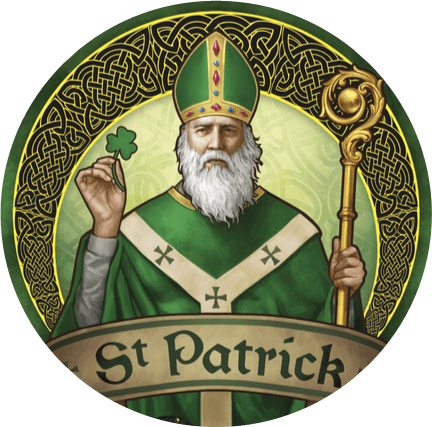
Feast Day Celebration
Each year, we honor our patron saint, St. Patrick, by gathering for our traditional Corned Beef & Cabbage Dinner. This festive occasion typically takes place on the Sunday preceding St. Patrick's Day, celebrated annually on March 17th (if St. Patrick's Day coincides with the 17th, our celebration will be held on that day.)
Saint Patrick Quick Facts
- Feast Day - March 17
- Patron saint of Ireland, Nigeria, migrants, and engineers.
- He was abducted by Irish pirates and sold into slavery at the age of 16.
- St. Patrick begins his Confessio with the beautiful and humble phrase, "My name is Patrick. I am a sinner, a simple country person, and the least of all believers."
- The original color associated with St. Patrick wasn't green - it was blue.
- Many believe that St. Patrick used the symbol of the shamrock – the three-leafed clover – as a means of evangelization; the three leaves represent the Holy Trinity of God the Father, the Son, and the Holy Spirit.
St. Patrick: The Great Apostle of Ireland
St. Patrick stands as one of the most renowned saints globally, honored by millions and revered through numerous churches dedicated to his memory.
Born in the late fourth century A.D. (c. 385) in Roman Britain, precisely where remains debated among historians, St. Patrick is enshrouded in legend. One of the most enduring tales credits him with banishing snakes from Ireland, though we know there have never been snakes in Ireland. This legend likely emerged from his pivotal role in spreading Christianity across the land, earning him the title "Apostle of Ireland."
St. Patrick was kidnapped when he was around 16 by Irish raiders in his homeland and taken to Ireland where he was enslaved for several years. According to tradition, he spent six years in the Slemish Mountain region in Northern Ireland as a shepherd of pigs and sheep. In his captivity, he found solace in prayer, strengthening his faith even amidst hardship.
After six years as a slave, Patrick had a divine dream prompting his escape to the coast, where he found passage back to Britain. Reuniting with his family, he continued his studies for priesthood, eventually being ordained by St. Germanus, Bishop of Auxerre.
Following another divine vision calling him to return to Ireland, Patrick embarked on his mission. Landing in Slane on March 25, 433, he faced opposition but also converted many, including a chieftain named Dichu. Over forty years, Patrick and his disciples spread Christianity throughout Ireland, building churches and converting kings and kingdoms.
Saint Patrick's Day is observed on March 17, the supposed date of his death in Saul, Downpatrick, Ireland, around 493. It is celebrated inside and outside Ireland as a religious and cultural holiday. In the dioceses of Ireland, it is both a solemnity and a holy day of obligation; it is also a celebration of Ireland itself.
In His Footsteps
Patrick's example of devotion and trust in God should guide us all, reminding us of the importance of faith and humility in our lives.
As we read in his Confessio,
"So I am first of all a simple country person, a refugee, and unlearned. I do not know how to provide for the future. But this I know for certain, that before I was brought low, I was like a stone lying deep in the mud. Then he who is powerful came and in his mercy pulled me out, and lifted me up and placed me on the very top of the wall. That is why I must shout aloud in return to the Lord for such great good deeds of his, here and now and forever, which the human mind cannot measure." —St. Patrick